
Princes Hill Heritage Home Extension Targeting Passivhaus
This Princes Hill Federation home retains much of its original character, from its deep red tuckpointed brick façade and leadlight windows to its slate roof, tall chimneys, and return verandah detailed with decorative wrought iron fretwork.
Currently under construction and due for completion in early 2027, the project reimagines the home for contemporary family living through a two-storey rear extension targeting Passivhaus certification and a new garage accessed from the rear laneway.
Project Overview
Suburb – Princes Hill
Period – Federation
Heritage Status – Contributory within HO329
Originally Built – 1910s
Status – Under construction
Architect & Interior Designer – Jane Cameron Architects
Project Architect – Jamie Lim
Builder – Hone Built
Passivhaus & ESD Consultant – Paul Grey, Detail Green
Passivhaus Certifier – Marcus Strang, HIP V. HYPE
The Brief
The brief was to transform the existing house into a long-term family home capable of adapting through changing stages of life — from childhood through to the teenage years and beyond.
Key priorities included creating generous living spaces connected to the garden, accommodating working from home, and designing a kitchen for a family who love to cook and entertain.
The project also sought to create a home that would deliver exceptional comfort, low operational energy use, and long-term adaptability.
Relationship Between Old and New
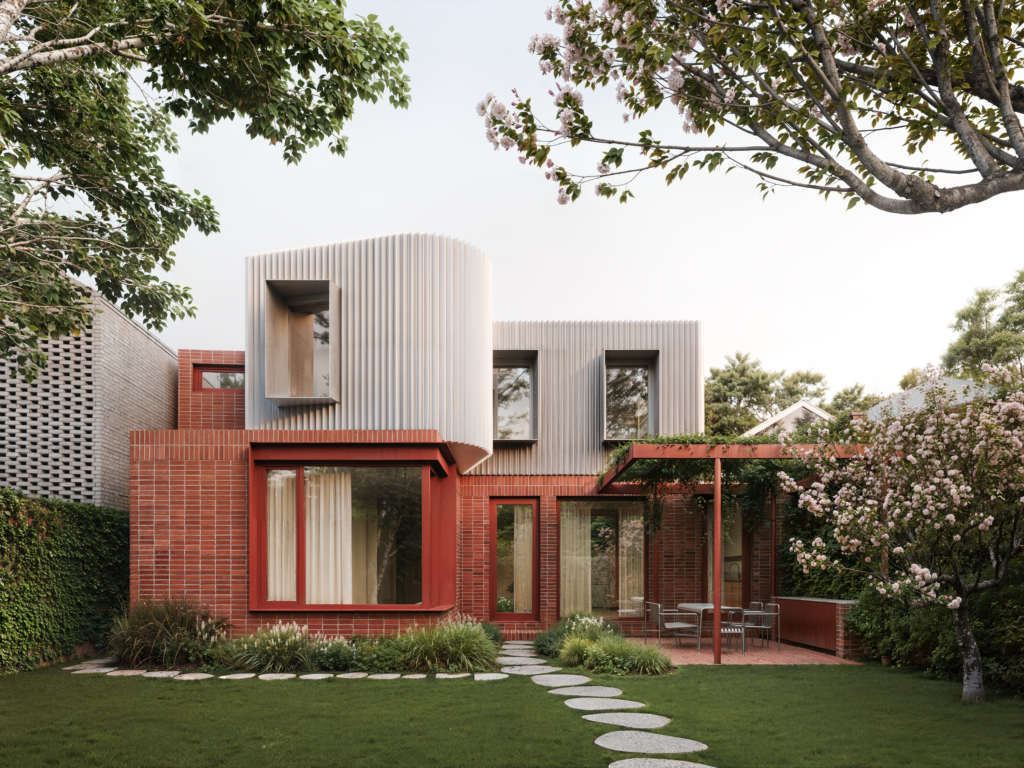
Rather than replicating the original Federation home, the design establishes a dialogue between old and new. While the extension draws on the materiality, colours, and architectural language of the original house, it is expressed as a clearly contemporary addition.
At ground level, bricks salvaged from the demolition works are reused within the extension and garage, creating a direct material connection between the original home and the new addition. The mortar colour has been carefully matched to the original brickwork, referencing the underlying masonry tone that existed prior to the application of traditional tuckpointing.
While the material palette draws from the original house, the detailing shifts to clearly distinguish old from new. Rather than replicating the original running bond brickwork, the extension adopts a stack bond pattern with raked joints — using familiar materials in a distinctly contemporary way.
At first floor level, the expression becomes lighter and more overtly modern, with crisp white profiled cladding that draws on the white detailing of the existing house.
Additional architectural elements reinterpret Federation motifs in a contemporary language. Window shrouds at the upper level provide solar control and privacy while offering a contemporary response to traditional Federation awnings. Metalwork elements, including the pergola, window hoods, and glazed framing, are finished in Manor Red, subtly referencing the home’s heritage character.
The landscape design also references the existing home, with bluestone paving drawing on the bluestone edging of the original verandah.
This dialogue between old and new continues internally, with a material palette that draws on the colours and textures of the original home while introducing a contemporary refinement.
Deep reds, warm whites, terracotta tones, and muted sage are introduced through joinery, tiles, and finishes, creating continuity between the exterior and interior. Polished Ceppo Sicilia stone helps bring these tones together within a single expressive material.
Balancing Heritage and Performance
While the new rear addition is targeting Passivhaus certification, the original Federation home is being upgraded through a more measured approach.
The existing house was in sound condition and retained many significant period features, including original stained-glass windows, decorative fireplaces, ornate cornices, ceiling roses, and other heritage detailing. Achieving full Passivhaus certification for the existing building would likely have necessitated extensive intervention, including significant alterations to the original fabric and the removal or replacement of valued heritage features.
Had the original house been in poorer condition, a more substantial intervention may have been a more appropriate response.
These upgrades include new ceiling insulation, sub-floor insulation, electric hydronic heating powered by a heat pump, and concealed bulk heat pump cooling systems. The thermal mass of the original solid brick construction also helps regulate internal temperatures, reducing temperature fluctuations and enhancing year-round occupant comfort.
Solar panels and battery storage further support the home’s low-energy operation, helping to offset operational energy use.
Performance Strategy
The new rear addition has been designed to deliver a markedly different level of environmental performance, targeting Passivhaus certification and the comfort, efficiency, and indoor air quality outcomes associated with this rigorous building standard.
A continuous, well-insulated and airtight building envelope helps create a stable internal environment with minimal heating and cooling demand. Careful detailing reduces thermal bridging at building junctions and structural connections, further improving performance.
The extension incorporates Logikhaus aluminium-clad timber triple-glazed windows and glazed doors. These improve thermal comfort, reduce heat loss, minimise overheating, and enhance acoustic performance.
Mechanical ventilation with heat recovery provides a continuous supply of filtered fresh air while recovering warmth from outgoing air. Together with the high-performance building envelope, this helps create more stable indoor temperatures, fewer draughts, improved air quality, reduced external noise, and a calmer, healthier home.
Currently Under Construction
This project is currently under construction. The visualisation shown reflects the design intent for the completed extension, a contemporary addition carefully integrated behind the retained Federation home.
We look forward to sharing construction progress and completed project photography.
Continuity Across Time
Across Melbourne, period homes continue to evolve as families seek greater comfort, functionality, and environmental performance.
Each project requires its own balance between preservation and change — understanding what should be retained, what can be adapted, and how new interventions can respectfully contribute to the life of the home.
At Princes Hill, the answer lies in a careful dialogue between old and new — pairing a respectful renovation of a Federation home with a contemporary extension targeting Passivhaus certification.
For a different approach to improving the performance of an existing home, see our Fitzroy Retrofit Targeting Passivhaus project, where the focus is on deep retrofit within a heritage setting.
We welcome conversations with homeowners considering a heritage renovation, contemporary extension, or Passivhaus project in Melbourne — often beginning with a calm and informed Master Plan Session.
You can also read reflections from past clients and collaborators on our testimonials page.
Last reviewed: June 2026